
One of the most radical, risky, and exciting drivers of change is scaling up. When it comes in so many forms — personally, professionally and organisationally — it can be easy to be caught up and confused by the complexity around you.
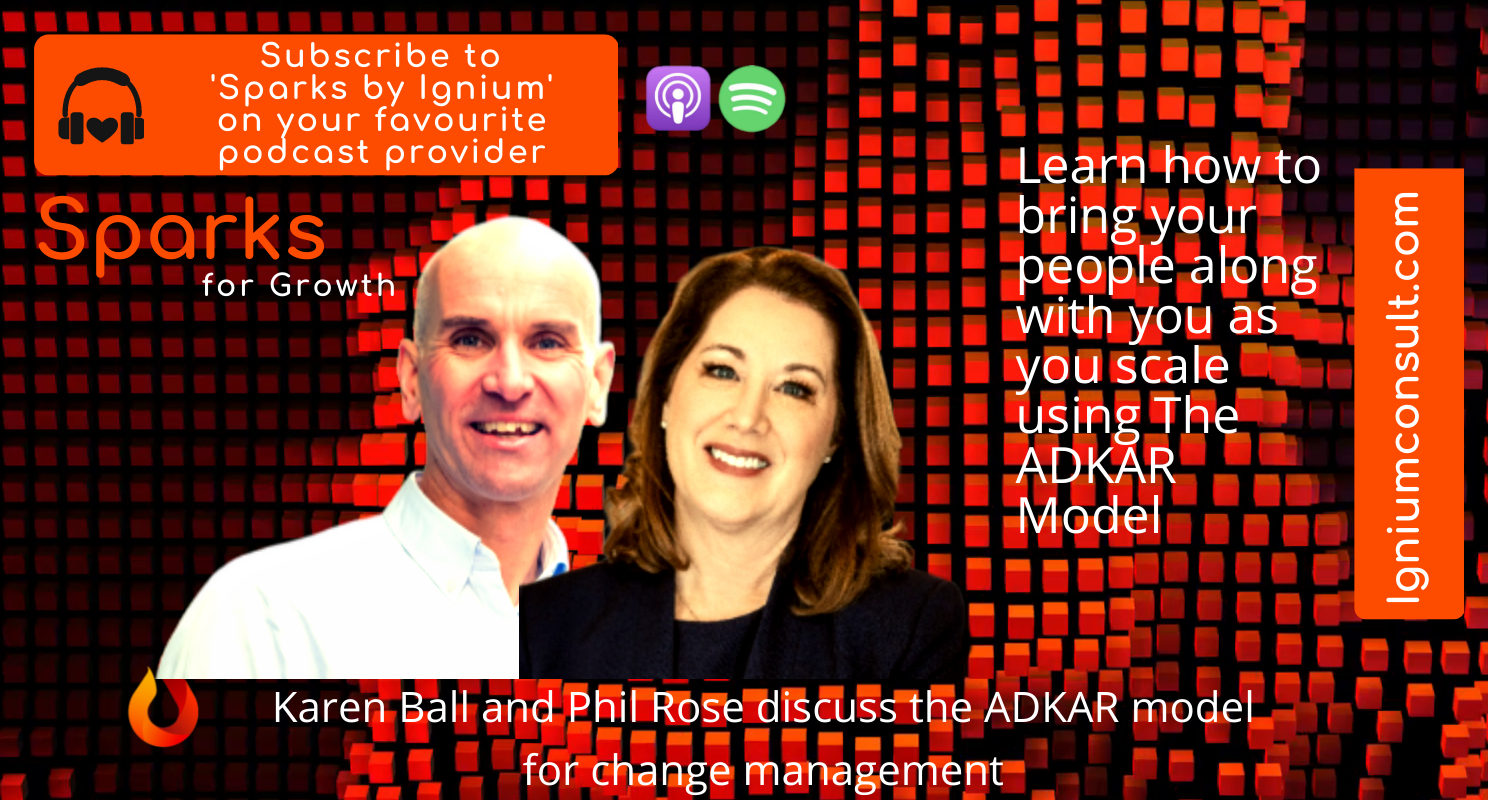
In this article, we look at the ADKAR model and how it can be particularly useful in bringing everyone along with you as you scale. Drawing on our discussion with the author of The ADKAR Advantage and Sparks by Ignium podcast guest, Karen Ball, we explore how to manage change as you scale. It’s all about disabling fear and unlocking potential.
🎧 Catch the full conversation on the Sparks by Ignium podcast on Spotify here
Change comes in many forms
No matter the size or cadence of change, it’s likely to be met with open arms by some and resistance by others. Change can involve processes, systems, culture, behavioural expectations, compensation, location, and structure.
‘An organisation with twenty thousand employees has twenty thousand ADKAR journeys.’ Karen says. It’s no wonder that it can leave some business owners feeling overwhelmed. Still, it’s also an opportunity to attune and align the workforce — not as cogs in a machine but as valued individuals.
The ADKAR model explained
With its five bold elements, we love this model because it marries organisational and human change together. Each step in the acronym is sequential, with the first two forming the foundation.
A – Awareness
The first building block involves being able to articulate the why, why now and what happens if we don’t? in a plain, simple and relatable way. Data and metrics can be dry on their own, so what matters is bringing them to life by providing logical context and then wrapping them in emotion and story.
D – Desire
One of the most difficult sticking points when managing change is overcoming resistance. You can design and implement the perfect system but if your people can’t call it their own, it won’t work.
‘We all get to choose to come alongside.’ Karen says. ‘A great phrase to use is tell me more.‘
K – Knowledge
‘In essence, this is training people how to do what we want them to do.’ Karen says. Taking an inclusive approach requires a structured method to ensure we recognise the diverse learning styles within the team.
A – Ability
‘Taking a golf lesson is all about knowledge; putting me out on the course is about ability.’ Karen explains. It takes time to become proficient, so we need to allow for the fact that results will not happen overnight.
R – Reinforcement
This is what we do to make sure change sticks. The problem is, as humans, we’re very good at accepting change on the surface but when it gets difficult, we revert to what we did before because it’s comfortable.
The main takeaway
When a new system, culture or structure is being introduced, ROI depends on adoption, not installation. In other words, change management isn’t a nice-to-have when you’re scaling: it’s essential.
The beautiful thing is that the ADKAR model can be used with any size organisation in any sector — even in your personal life.
We’ve had some amazing results and we’d love to share them with you. Drop us a message if you’d like to set up a call, and let’s talk about how we can help you manage change while you scale. Find more leadership insights in the Ignium Spark Tank or explore our coaching services.