Grow your purpose-driven business with confidence by learning from a groundbreaker. We celebrate the work of eco-minded troublemaker and risk-taker Robert Barnard-Weston in 3 inspirational quotes.
Straight out of the gate, the new government is talking of economic reform and transformation. Political opinions aside this gives us all an opportunity to ride a wave of optimism missing for some time. But how do you grow your purpose-driven business with confidence?
With the gift of what seems like a clean slate in front of us, it’s a chance to refocus on how what we do benefits the wider world but can we really rewrite the rules and put purpose first? Are our ambitious plans a bit far-reaching?
The podcast we didn’t know we needed
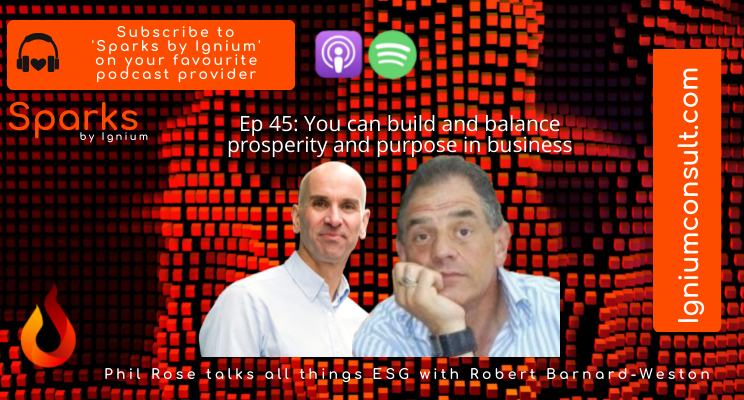
It seems like the ideal time to look back on a conversation we had in 2022 with the man known as the modern father of sustainability Robert Barnard-Weston.
Even though he sadly passed away in late 2023, his words are more relevant (and needed) now more than ever. His confidence was infectious and his ability to reframe a challenge as an opportunity, inspiring. This is just the energy and assurance we need at the moment.
So we share three inspiring quotes from the conversation but please make a date with yourself in your diary to listen to the full podcast episode available here. It’ll have you buzzing by the end.
‘It seems to me rather absurd that if in the name of profit, we deny ourselves profit opportunities as well as cause ecological damage done by our profit-only focus, that’s not shooting ourselves in the foot, that’s machine-gunning both our feet off.’
Robert’s approach to business was revolutionary. Co-founder of Bath’s first eco-hotel, he was behind the modern-day UK’s farmers’ market movement. With his hand in a number of other ambitious projects including those for vulnerable and disadvantaged people, his microcosm mindset could see the opportunities others had missed. Assured of his methods, he taught others to do the same.
‘There is no waste in nature,’ he said ‘the only ones creating waste are us humans. Corporate behaviour is wasteful – and that’s wasteful!’ He gave a great example of how by-products from a brewery were used to grow shiitake mushrooms. In turn, the by-products from this were used to feed cows and chickens and their waste was then used to create energy for the brewery.
Rather than downsizing to preserve profit when times are tight (which in his mind was a very linear, limited way of thinking), ‘upsizing’ allows us to think systematically. The above example shows how the innovative revaluing of what we carelessly throw away benefits finances and the planet. It’s genius.
‘Profitability and purpose are mutually enhancing if you just think it through and understand that’s the beacon you’re heading for. Get a team of people focused on getting to the beacon too. Prove the point.’
The most successful businesses are the ones where purpose goes beyond making money. People turn up for work with their blood, sweat and tears because they believe in what they’re doing. Comms play a central role in transforming employee engagement and with his background in copywriting and marketing in mind, he gave us 4 questions to answer.
- What’s your strategic narrative? What does your organisation stand for? ‘If it’s only going to get rich people slightly richer, who’s going to endorse that?’
- Do your employees feel heard? They need to know that an exceptionally good idea will make it to the board – or that their problem or issue will be acknowledged and dealt with.
- Do your people feel like human beings or human resources?
- Does your organisation do what it says it’s going to do in the world or is there a gap between words, intentions and actions?
It boils down to whether your workforce feels proud to work for you. ‘Everything that has worked well in my experience has had communication at its heart’ Robert said.
‘There are two ways to look at climate change. Is it the worst thing that could have happened to humanity or is it the biggest business opportunity we’ve ever had?’
Robert talked fondly of the ‘Aha!’ moments he’s witnessed during his career: including his own. The realisation that things won’t get better for our world unless we do something.
‘Freud said that humans are somehow able to be fully aware and fully ignorant of the same fact in the same person at the same time. Which is a weird behaviour of humans that most species sensibly avoid.’ he said.
The birth of his daughter and then his granddaughter decades later spurred him on to bring sustainability and profitability onto the same page. ‘We’ve got to clean up our act’ he said, ‘but we need systemic rather than linear thinking.’
All it takes is for one person to stand up and show us that it’s all possible. Robert certainly did that and we’re so grateful that he did.
If this has given you your own ‘Aha!’ moment, fantastic.
It’s easy to listen to the sustainability message and lose confidence when the fear of failure strikes but when you hear a story like Robert’s you understand the mechanics of a successful purpose-driven business. It’s not a matter of hoping for the best – if there’s a well-designed strategy in place, it will work.
We’re specialists in putting purpose into the heart of a robust business plan. If your passion is people and planet as well as profit, let’s talk and get you on your way.