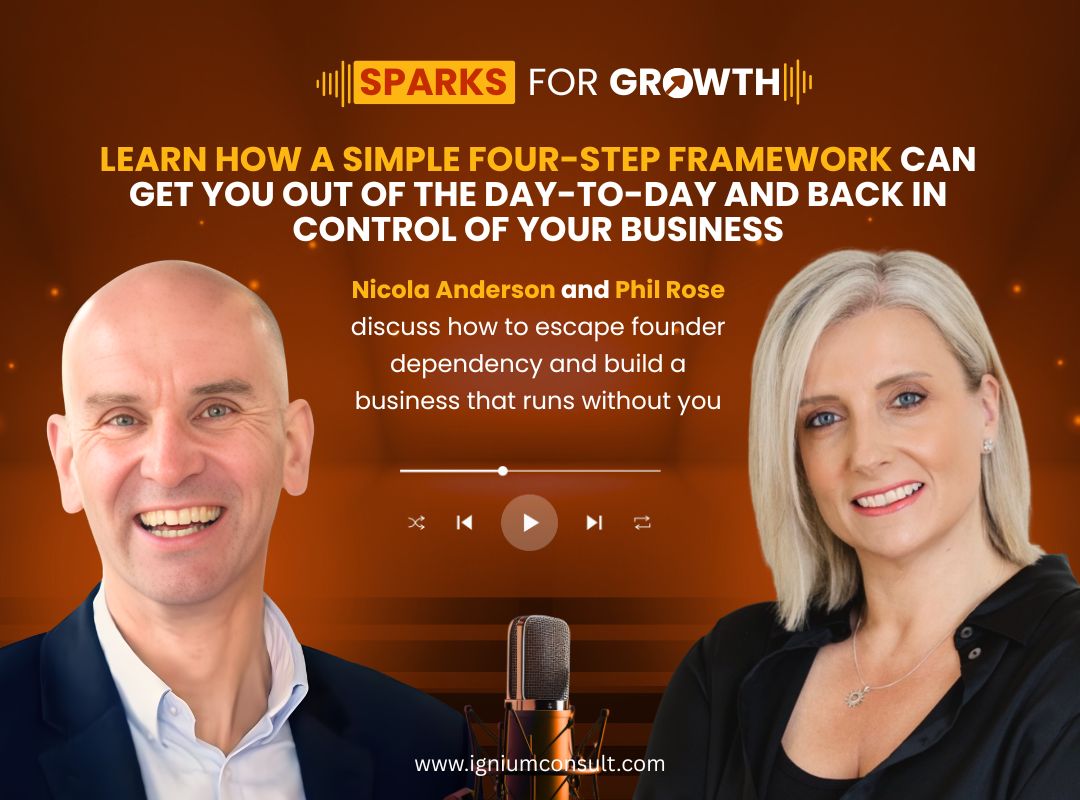
A look at Nicola Anderson’s DASH Framework, and what it takes to build a business that doesn’t need you every hour of every day.
Every business starts with the founder doing everything. In the early days, that’s not just normal — it’s necessary. But somewhere between the first hire and a ten-person team, a pattern sets in that Nicola Anderson, founder of the business growth consultancy Capacity to Grow, has come to call founder dependency. On a recent episode of Sparks for Growth, Nicola sat down with host Phil Rose to unpack exactly what that means, why it quietly damages growth, health and family life, and what to do about it.
What Is Founder Dependency?
Nicola works with founder-led businesses at the £5 million-plus mark the point, she explains, where what got you here won’t get you there. “What gets you to five million doesn’t get you to ten million plus,” she says, “because it’s a different type of model.” Her clients typically have a team of five, ten or more people, and yet almost every decision, question and problem still lands on the founder’s desk.
It’s a phrase Nicola only started using in the last 18 months, once she recognised the common thread running through her client work: “What I’m really doing in helping businesses move on from that five million plus point is helping the founder get out of the day to day.” You become the hub, and everything every decision, every fire, every piece of direction has to flow through you.
The knock-on effects aren’t just structural. They show up in health, in relationships, and eventually in the value of the business itself. If a business is entirely dependent on its founder, Nicola points out, that founder is effectively tied to it indefinitely even at the point they’re trying to exit.
The DASH Framework
To help founders find their way out, Nicola uses a framework she calls DASH: Delegate, Automate, Stop, Hire. The order, she’s clear, is deliberate.
Delegate comes first, and it’s also the hardest. Nicola starts by asking what could be handed to someone else — not how, just what. Crucially, she also asks what the founder actually enjoys doing, because “there’s no point in building a business you don’t enjoy either.”
Automate is next: what repeatable, everyday tasks could a system, a piece of software or AI take off your plate?
Stop follows and it’s often the most overlooked step. After years of running a business, Nicola says, there’s usually a layer of activity that simply doesn’t need to happen any more. “Because we’ve always done it that way doesn’t necessarily mean we always need to keep doing it that way.”
Only once delegate, automate and stop have been worked through does Nicola get to Hire. Reach for a new hire too early, she warns, and you risk it becoming “a sticky plaster” solving today’s problem while quietly creating tomorrow’s, as that new hire’s role fills up and more decisions start flowing back to you anyway.
Asked which part of DASH matters most, Nicola doesn’t hesitate: delegation. “We’re used to doing everything ourselves. We know that if we do it, it gets done and it gets done the way we want it done.” Handing that over means trusting someone else with your business, and for a founder who’s built everything from scratch, that’s genuinely difficult.
Why Letting Go Is So Hard
Underneath the practical mechanics of delegation, Nicola identifies something more personal: identity. “This is me, this is my identity. If I’m not doing this, who am I?” Many founders also carry a quieter fear — that clients themselves have come to expect direct access, and that stepping back means an uncomfortable renegotiation of how the business operates day to day.
Getting the structure right matters too. Nicola often finds that job descriptions don’t match the roles people are actually doing, or that a small, tight-knit early team has simply never been revisited as the business has grown. And when founders do hire, they tend to gravitate toward people like themselves a mistake Nicola sees often. A team full of fast-moving, ideas-first personalities, she says, can generate plenty of energy but struggle to get the detail work done. To avoid it, Nicola uses a profiling tool called Contribution Compass to understand a team’s existing balance and hire to complement it, not duplicate it.
The Cost of Doing It All Yourself
Perhaps the most striking moment of the conversation wasn’t about frameworks at all. Phil shared the story of a founder he’d met in London on his third cancer scare, trying to sell his business, and surviving on four hours’ sleep a night at 60 years old. Nicola’s response drew on her own background in construction: if health is the foundation, you can’t build on top of a weak one. Eventually, it all tumbles down.
It’s a theme that runs through the whole episode. Founders, Nicola says, often treat long hours as a badge of honour a mindset she believes is generational, and one that the next generation of business owners appears to be shedding. The warning signs usually show up away from work first: missed family moments, strained relationships, a health scare that finally forces a pause.
Nicola’s One Piece of Advice
Asked for the single most important thing a stuck founder should do, Nicola doesn’t offer a framework, a tool or a checklist. She offers one word: pause. “Step out of the workplace. Even if you can just go and sit in a coffee shop with a nice view, stop and think what is my life now, and where do I want it to get to?”
It’s advice she’s tried to live by herself. Later in the conversation, asked about her own vision of founder freedom, Nicola describes a lifestyle business, freelance support to keep things moving, and a gîte in the Dordogne she hopes to be working from within the next five years — a nod, she says, to Daniel Priestley’s recent writing on the value of building a business that gives you a life, not just an income.
The Takeaway
Founder dependency isn’t a sign of failure it’s what happens when a business built by one person keeps growing without the structure to match. Nicola Anderson’s DASH Framework offers a practical, sequential way through it: delegate before you automate, automate before you stop, stop before you hire. But perhaps the most useful takeaway from this episode is the simplest one before you do anything else, pause.
🎧 Hear the full conversation with Nicola Anderson on Sparks for Growth, available now on Transistor, Apple Podcasts and Spotify.
Connect with Nicola on LinkedIn or or find out more about her work at capacitytogrow.com.